The Soulanges Territory
While Indeinous peoples had known the area for millenia, European settlement in the Soulanges territory began in October 1702, when the Governor of Montreal, Louis-Hector de Callière (1648-1703), granted a seigneury to Pierre-Jacques de Joybert de Soulanges (1677-1703). However, the reign was abruptly interrupted by the passing of Pierre-Jacques a year later, at the age of 25. His wife, Marie-Anne Bécard de Granville (1677-1767), succeeded him and took charge of the new Soulanges seigneury.
Despite repeated requests, it took several years before the Soulanges seigneury was officially created by the young King Louis XV (1710-1774) and the Regency Council of New France on December 7, 1716.
Over the years, several families settled in the area, and by the end of the French Regime, nearly 300 households had made it their home, primarily cultivating the land.
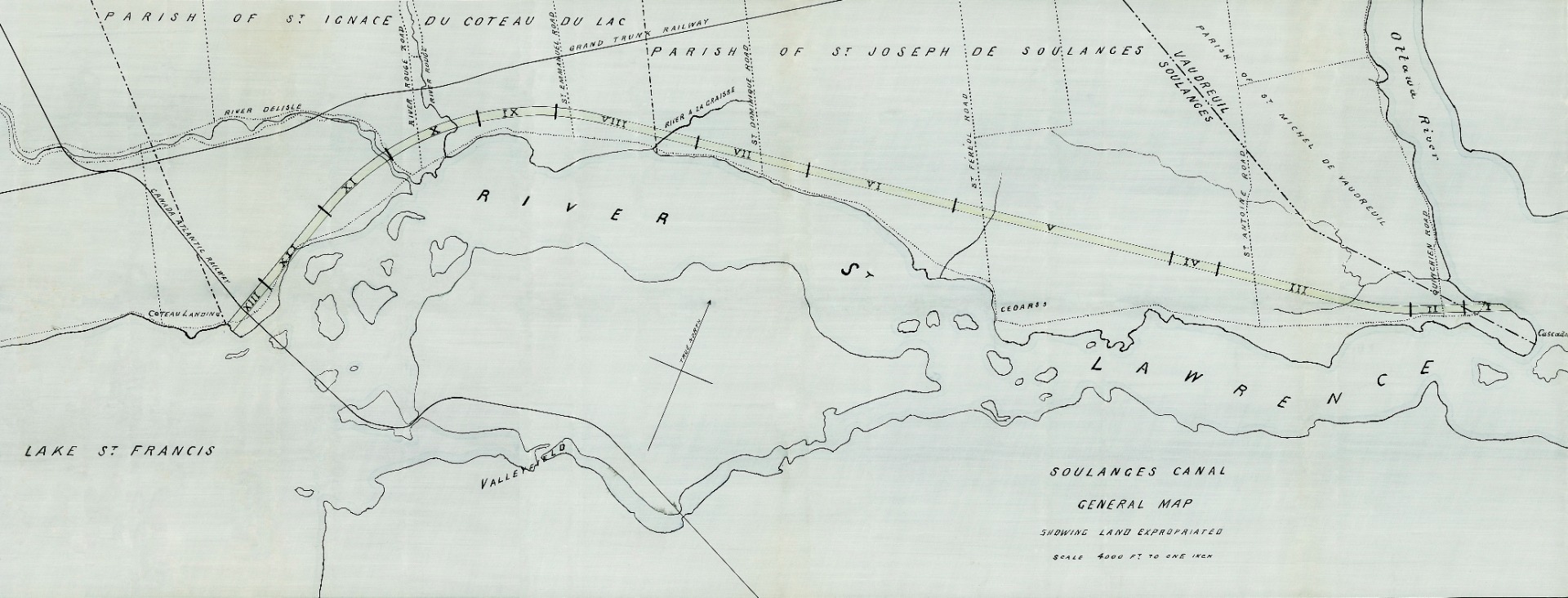
By 1765, three major village centers had developped : Pointe-des-Cascades, Les Cèdres and Coteau-du-Lac.
By the late 19th century, when the decision was made to build a new canal, several villages had already been established in the area, spurred by the arrival of the railway in 1855, the expansion of the road network, and a growing population.
Despite these changes, agriculture remained the primary activity, and the construction of the Soulanges Canal had little impact on rural living conditions or the economy of most of the residents. Only the four municipalities along the canal (Pointe-des-Cascades, Les Cèdres, Coteau-du-Lac, and Coteau-Landing, now Les Coteaux) experienced significant disruptions to their landscapes and daily lives.
-3vlxohk.png?alt=media&token=f28b675a-05de-4091-9df4-9d208d5dd244)